Beach nourishment is commonly used to restore or maintain an eroding shoreline by placing suitable sand on the beach. It can improve beach profile and provide a natural-looking shoreline, but the placed sand remains exposed to waves, currents and sediment transport and may require periodic replenishment.

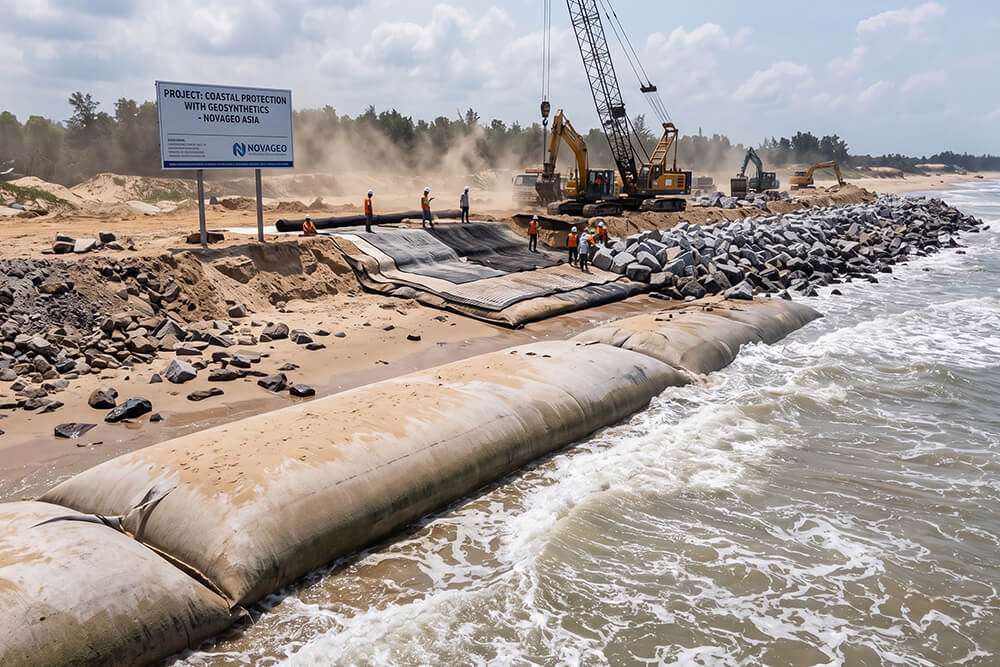
Geotextile tubes can be incorporated into a beach nourishment solution as a submerged or partially buried containment. The arrangement and function depend on the project site and design conditions.
The Engineering Challenge: Managing Beach Sand Loss

  • Sand placed through nourishment can be redistributed by waves, currents and storms, resulting in changes to the beach profile and loss of material from the target area.
  • Where sediment transport is significant, periodic nourishment may be required to maintain the desired beach profile.
  • Local scour and erosion can occur around structures and at transitions, depending on the wave and current conditions.

A suitably designed geotextile tube system may help manage these processes by providing a physical structure that influences wave conditions or sediment movement. It should not, however, be considered a universal solution for preventing beach sand loss.

Core Functions of Geotubes in Nourishment Projects

Submerged Breakwater Structure

A geotextile tube positioned offshore or nearshore can act as a low-crested submerged structure. Its geometry, crest elevation and position influence wave transmission, breaking and energy reaching the beach. The required arrangement should be established through coastal and hydraulic design.

Sediment Retention – Groynes Structure

Geotextile tubes can be arranged perpendicular or parallel to the shoreline, depending on the intended function. They may influence longshore sediment transport and help retain nourishment within a defined beach area, subject to the local sediment transport regime.

Storm-Induced Erosion Protection

Geotextile tubes can be buried beneath the beach profile to provide beach protection during occasional extreme conditions. The tube may remain covered under normal conditions, while its performance during storm-induced erosion depends on the geometry, burial depth, exposure, and overall stability of the system.

Material and Structural Performance Considerations

ParameterTypical ConsiderationMain Function
Tensile Strength (MD/CD)Selected according to filling height, handling, installation and service conditions.Resists tensile stresses during filling and service.
ขนาดช่องเปิดที่ปรากฏ (AOS)Selected based on the fill material and required dewatering/retention performance.Retains solids while allowing water to drain.
Puncture and Abrasion ResistanceSelected according to handling, installation and site exposure.Reduces risk of damage during installation and service.
UV ResistanceConsidered where the tube remains exposed before covering or submergence.Reduces degradation during UV exposure.

Technical Design Considerations

A geotube-reinforced beach nourishment system should be assessed as a complete coastal and geotechnical system.

Hydrodynamic Loading

Design wave conditions, water levels, currents, storm surge and wave transmission.

Geotechnical Stability

Bearing capacity, sliding, overall stability and settlement of the foundation.

Hydraulic Filling

Available fill material, slurry concentration, pumping pressure, filling sequence and dewatering behaviour.

Scour and Toe Protection

Potential scour around the structure and the required toe protection or scour apron.

Foundation Stability and Settlement

A filled geotextile tube can impose significant load on the underlying seabed. On soft clay or silt, foundation stability and settlement should therefore be assessed. Where required, geotextile separation, stabilization or reinforcement can be incorporated beneath the tube based on the geotechnical design.

Toe Scour Protection

Wave and current action can cause local scour around the toe of coastal structures. Where analysis indicates a scour risk, suitable toe protection, scour aprons or other measures should be provided and designed for the expected hydraulic conditions.

Dewatering and Consolidation

Geotextile tubes are filled with a slurry through designated filling ports. The geotextile allows water to drain while retaining the solid particles. Final tube dimensions depend on the fabric properties, fill material, filling method, pumping conditions and consolidation behaviour. The final profile should therefore be established from project-specific design and installation considerations rather than a single assumed shape or solids concentration.

Field Installation Best Practices

  1. Prepare and survey the installation area and remove large rocks, sharp objects and debris that could damage the geotextile.
  2. Position and secure the tube, filling ports and any required anchorage before pumping.
  3. Control the filling rate and pressure and distribute the slurry as evenly as practical to achieve the required tube profile.
  4. Monitor the tube dimensions and surrounding conditions during filling and consolidation.
  5. Where the tube is intended to remain covered, place the specified cover material after filling and consolidation to provide the required protection.

บทสรุป

Combining geotextile tubes with beach nourishment can provide an engineered approach to managing coastal erosion and sediment movement. The effectiveness of the system depends on the coastal processes, tube configuration, foundation conditions, fill material and overall project design. Geotextile tubes should therefore be designed as part of the complete coastal protection and nourishment system. For engineering support for your coastal protection project, visit Novageo Asia to learn more about our flagship geotube product: NovaTube.


แชร์โพสต์นี้

บล็อกที่เกี่ยวข้อง