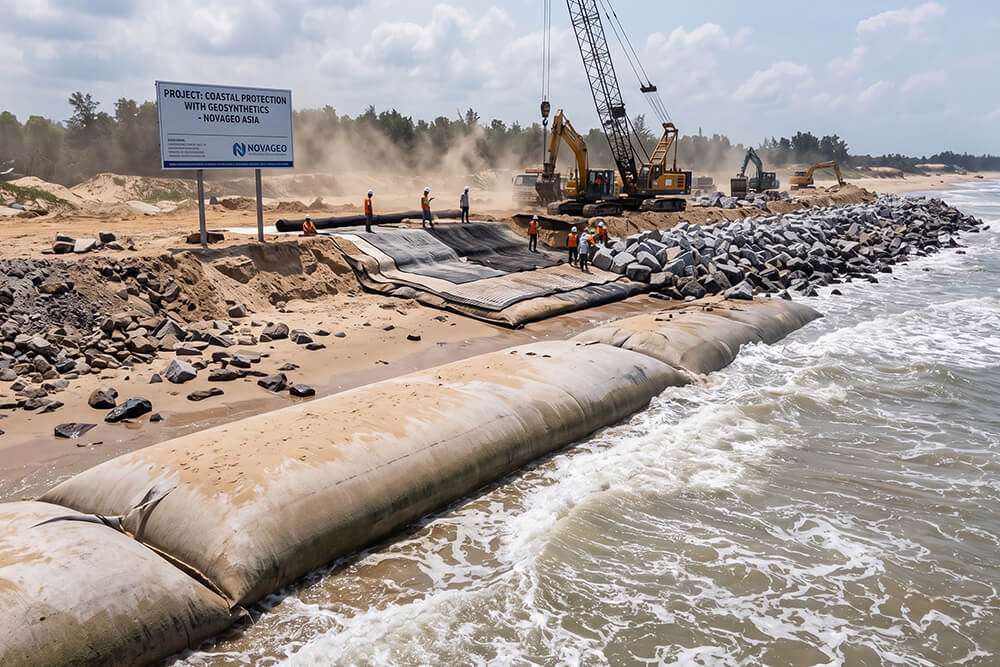
Coastal areas are exposed to waves, currents, tides, storm events and changing water levels. These conditions can cause erosion, scour and instability, which may affect shorelines and coastal infrastructure. Conventional protection systems such as concrete seawalls and rock revetments remain widely used, but they can require large quantities of materials, heavy equipment and careful foundation preparation.
Geosynthetics can be used as part of coastal protection systems to provide filtration, separation, erosion and scour protection, reinforcement, or containment. Depending on the site conditions and design requirements, geotextiles, geotextile tubes, geosynthetic sand containers and geogrids can complement or, in some applications, provide an alternative to conventional materials.
Geotextile tubes are large tubular containers made from high performance woven geotextiles. They are hydraulically filled with a suitable slurry, commonly sand and water or dredged material. During filling and dewatering, water passes through the geotextile while the solids are retained, forming a consolidated fill mass.
- Applications include breakwaters, submerged or nearshore structures, groynes, sills, containment structures and selected beach nourishment projects.
- A key advantage is that suitable locally available sand or dredged material may be used as fill, reducing the need to transport large quantities of rock.
- Important design considerations include fabric tensile strength, seam strength, fill characteristics, pumping pressure, required final dimensions and exposure to UV radiation and abrasion.
Geotextile filter layers can be installed beneath riprap, rock revetments and other armour systems. Their main function is to retain the underlying soil while allowing water to pass through, reducing the risk of soil particle migration and loss beneath the armour layer.
A geotextile filter may reduce or replace the need for a graded granular filter in suitable applications, subject to hydraulic, filtration, structural and installation requirements.
Geosynthetic sand containers are geotextile units filled with sand or other suitable material. They can be used to form revetments, dune cores, temporary protection or other erosion-control structures.
- The flexible nature of geotextile containers allows the system to accommodate some deformation and settlement, subject to the design and construction conditions.
- Where appropriate, the containers can be covered with sand, soil or other suitable materials to integrate the system with the surrounding environment.
Selection and design of geosynthetics for coastal applications should consider the site-specific hydraulic, geotechnical, mechanical and environmental conditions.
The filter geotextile should retain the underlying soil while providing adequate water flow. AOS and hydraulic properties should be selected based on the soil characteristics, hydraulic gradient and project design criteria. The filter should not be selected based on AOS alone.
During installation, geotextiles may be exposed to damage from rock placement, sharp objects, handling and construction equipment. The required puncture and installation-damage resistance should therefore be assessed for the actual site conditions and installation method.
Where geosynthetics remain exposed before burial, submergence or covering, UV resistance and the expected exposure period should be considered. The polymer type, stabilisation system and project-specific exposure conditions should be taken into account.
Geosynthetics can form an important part of coastal protection systems by providing filtration, separation, containment, reinforcement and erosion or scour protection. Successful application depends on selecting the appropriate geosynthetic and designing the complete system for the site-specific hydraulic, geotechnical, mechanical and environmental conditions.
To learn more about engineered geosynthetic systems, technical product specifications, and project engineering consultations, visit our Novageo Asia and reach out to us today!