

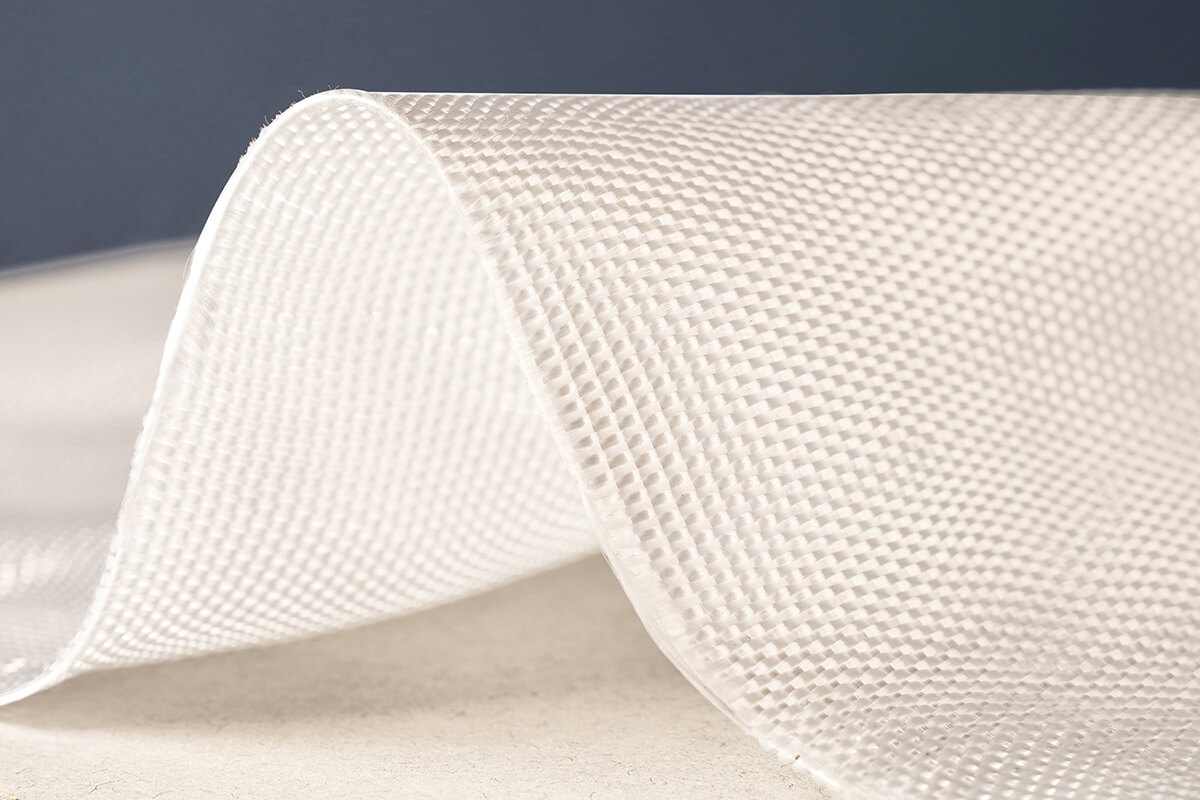
Woven Geotextile
Woven geotextiles are created by weaving individual threads (slit films or monofilaments) on a loom, similar to how clothing fabrics are made. This process creates a uniform, incredibly strong grid.

Non-Woven Geotextile
Non-woven geotextiles are manufactured by bonding fibers together using heat, chemicals, or mechanical needle-punching. The result is a felt-like fabric that is highly permeable.
Key Applications & Industry Solutions
Road Stabilization & Ground Reinforcement
Our high-strength woven and non-woven geotextiles act as a robust separation layer. By preventing the intermixing of the subgrade and the aggregate base course, the structural integrity of the road is preserved.
01
Slope Protection & Erosion Control
NovaGeo geotextiles are essential for stabilizing exposed slopes. They hold the soil in place while allowing water to drain freely, reducing hydrostatic pressure build-up within the slope.
02
River Bank & Coastal Protection
Acting as a critical filter layer, our geotextiles are placed underneath heavy armor units like rip-rap (large rocks), gabions, or concrete revetments.
03
Landfill Engineering & Subsurface Drainage
Our non-woven series provides superior filtration properties for environmental and drainage projects.
04
Why NovaGeo Asia?
FAQs
Geotextiles are permeable fabrics made from synthetic materials like polypropylene or polyester, used in civil engineering and construction projects. They serve functions such as separation, filtration, drainage, reinforcement, and protection in applications like road construction, erosion control, and retaining walls. Their durability and resistance to environmental conditions make them effective for long-term ground stabilization and infrastructure support.
Geotextiles are used in construction and engineering to separate different soil layers, provide filtration, allow drainage, reinforce soil, and protect structures. Common applications include road building, erosion control, retaining walls, landfills, and coastal protection, helping improve stability, prevent soil loss, and extend the lifespan of projects.